How Kenya’s Beneficial Ownership(BO) Registry is quietly exposing unregularized dual citizenship and what it means for your assets.
For many years, Kenyan diaspora investors have focused primarily on asset acquisition and wealth preservation. However, understanding Kenya BRS Compliance is now a critical step for all directors and shareholders. This major regulatory shift is quietly forcing a confrontation with an overlooked legal vulnerability: your official citizenship status.
Under the Business Registration Service (BRS) mandate, companies in Kenya must maintain and submit a digital Beneficial Ownership (BO) Register via eCitizen. While framed as an anti-money laundering and corporate transparency tool, it has inadvertently become a diagnostic test for identity and nationality.
What is a Beneficial Owner (BO) in Kenya? Any natural person who directly or indirectly holds at least 10% of a company’s shares or voting rights, can appoint/remove directors, or exercises significant influence or control.
The Historical Legal Trap
Many Kenyans who acquired foreign citizenship before August 27, 2010, legally lost their Kenyan citizenship under the provisions of the old Constitution. While the 2010 Constitution opened the door to dual citizenship, it did not automatically restore it.
The law requires individuals to formally apply to regain their Kenyan citizenship. Without that specific piece of paperwork, an investor born in Kenya remains, in the eyes of the state, a foreign national.
The implementation of the Beneficial Ownership registry effectively ends the era of unverified corporate filings. In the past, registries relied entirely on whatever information business owners self-declared on paper. Today, live digital links between corporate registries and immigration databases mean that unregularized citizenship statuses are instantly detected.
Why Digital BRS Audits Leave No Room to Hide
In the past, corporate registries focused primarily on corporate structures, nominee setups, or trust arrangements. The BRS framework bypasses these layers to isolate the ultimate human beings in control.
Filing requires the submission of precise data points that leave no room for ambiguity:
- Full legal name and residential address
- National Identity Card or Passport details
- KRA PIN and declared nationality
- Nature of ownership or control
If you are a diaspora investor declaring yourself as a Kenyan citizen on these portals, but your immigration files record you as having lost citizenship before 2010, you face an immediate regulatory mismatch.
Consequences of Non-Compliance: Fines, Land Loss, and Inheritance Traps
Misrepresenting your citizenship status on a corporate register isn’t just an administrative error; it triggers serious legal and financial liabilities.
1. The Land Ownership Cliff
Under Article 65 of the Kenyan Constitution, non-citizens and foreign-controlled companies cannot hold absolute proprietorship (freehold land) or leases exceeding 99 years. If a company holds land under citizen status, but BRS tracking reveals that a beneficial owner with 10% or more control is technically a foreign national, that company is instantly reclassified as a non-citizen entity. This places its land tenure in direct violation of constitutional limits.
2. Corporate Enforcement & Fines
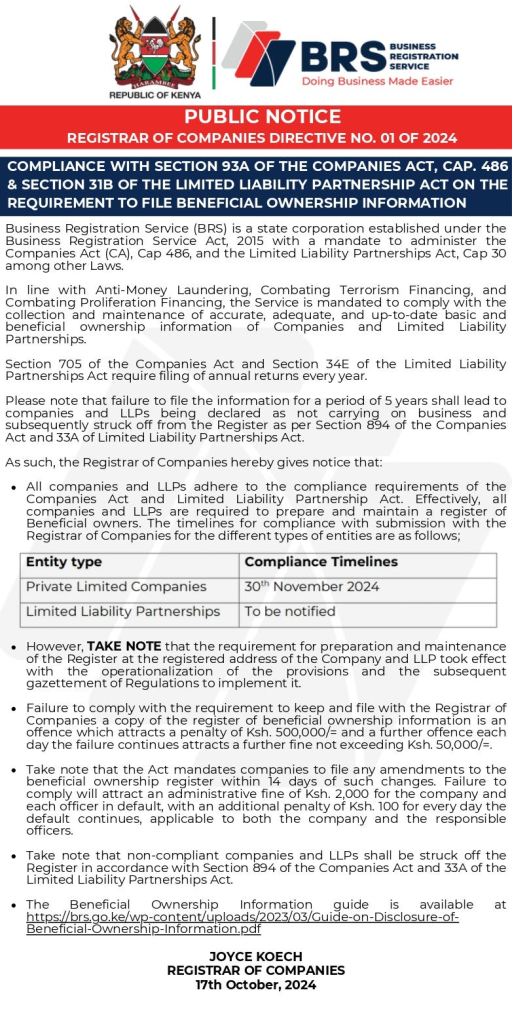
The penalties for failing to file accurate BO data or missing updates are aggressive:
- An initial fine of up to KES 500,000 for the company and its directors.
- Continuing non-compliance fines of up to KES 50,000 per day.
- The ultimate risk of the company being struck off the corporate register entirely, meaning it legally ceases to exist.
3. Asset & Succession Risks
If a business structure is deemed non-compliant or its land tenure is invalid, estate plans and succession strategies fail. Passing down a family enterprise to the next generation becomes a legal nightmare if the foundation of the corporate structure is compromised by an unverified nationality status.
Why Kenya BRS Compliance is a Wake-Up Call for Investors
Land ownership was the first warning sign. Succession planning was the second. BRS compliance may be the third.
For diaspora investors serving as directors, shareholders, or beneficial owners in Kenyan companies, regularizing your citizenship status is no longer just an immigration chore. It is now a critical step in corporate governance, legal risk mitigation, and wealth preservation.